
Everyday Robots
An embodied AI research moonshot project, exploring how AI/ML systems can co-inhabit spaces with humans and perform useful everyday tasks.
Human-Robot Interaction Design, Motion Design, Embodied AI
How can motion make an autonomous robot’s attention and intent understandable at a glance?
Everyday Robots must operate in human spaces to provide real-world value. However, placing high-velocity, high-mass machinery in these spaces creates a dual problem: a utility gap and trust paradox.
This complex feedback loop creates confusing problems for design, engineering, and research teams to navigate and collaborate on. In order to create trust, predictability, and safety – a robust framework is required that can guide teams towards a shared outcome.
The team began with a set of practical comprehension gaps: When is it safe to approach? What is the robot paying attention to? What will it do next? Does a person need to intervene?
These questions turned a broad trust problem into specific communication requirements that motion design could address.
The Utility Gap
For an Everyday Robot to be helpful with everyday tasks, it cannot be locked behind a safety cage; it must share the same physical space as humans.
The Trust Paradox
While utility requires proximity, it also breeds human anxiety. If the robot’s intentions are unreadable, it is perceived as “frightening” instead of helpful.


Core Principle: Transparent Intent
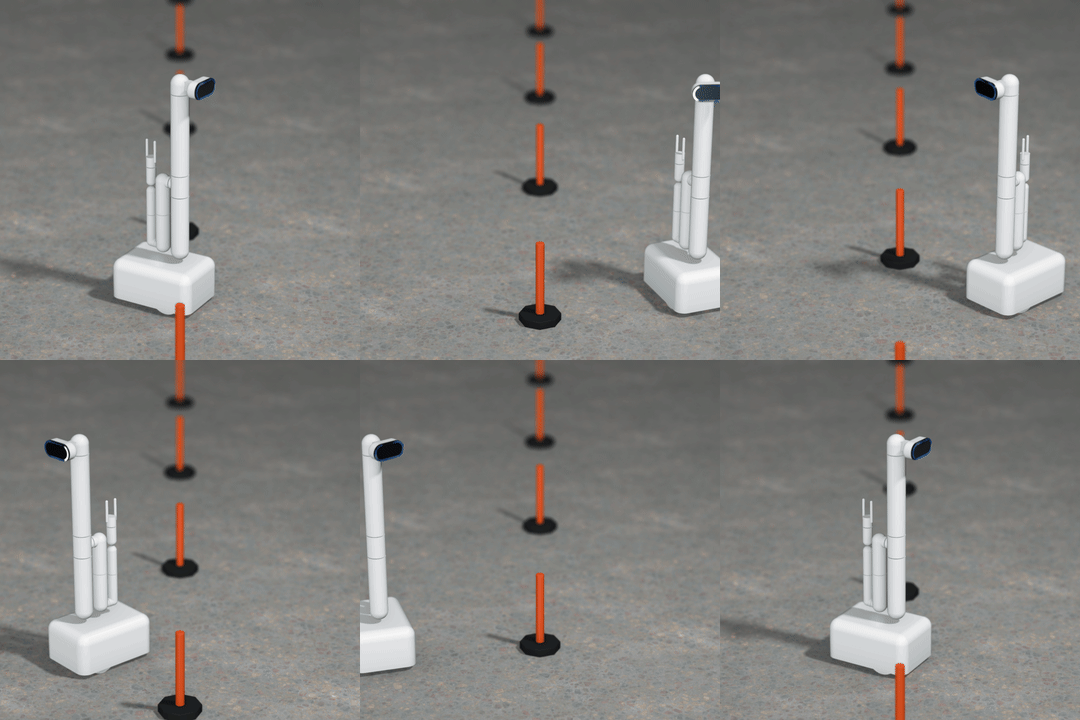
I aligned the design, research, and engineering teams around one shared principle of “Transparent Intent”: The robot’s current state and intent needs to be intuitively understood by users at a glance, and at a distance.
I translated that principle into a multimodal motion language:
The “Emoji” Lexicon
I architected a color-coded and motion-based grammar system and designed a library of 19 lo-res animations to encapsulate complex semantic meanings into language-agnostic signals that could be displayed on a head-mounted emissive light ring. The ring was designed to be legible from a distance, and from any angle.
The “Gaze” Context
I prototyped the implementation of a physical directional head with a full range of motion, despite it creating LiDAR blind spots and increasing mechanical weight. By using the head to ground the semantic “emoji” meaning in a person, object, or location, the robot was able to communicate efficiently with precision.